
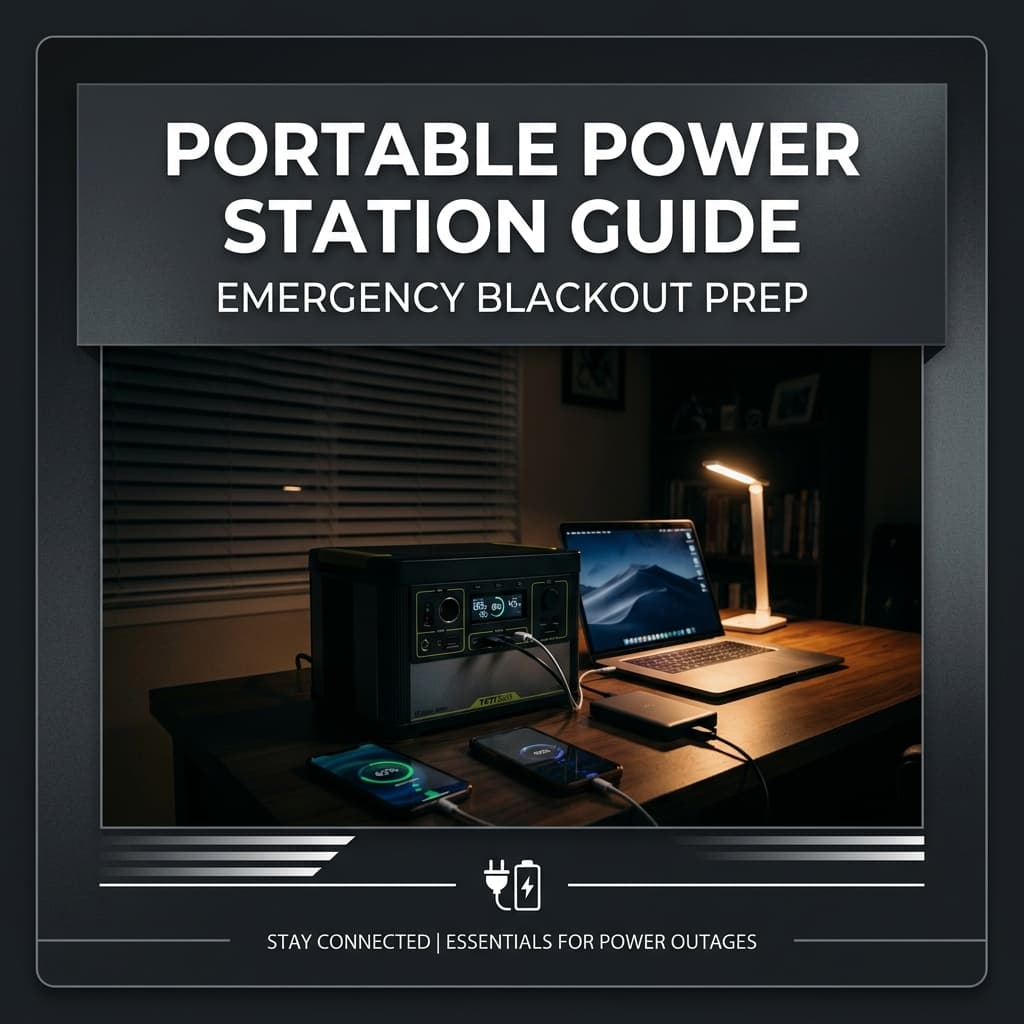
Safe backup power for a home emergency: compare options and build a practical checklist
Compare portable batteries, generators and installed backup systems. Calculate essential loads, check safe placement and prepare a clear shutdown and recovery plan.
Security and resilience editorial team · Source-reviewed editorial guidance based on public-agency publications; no product laboratory testing or professional certification is claimed.
Quick answer
Choose backup power around essential devices, required runtime and a safe operating location. A portable battery can support selected compatible loads; a fuel generator needs outdoor separation and strict connection precautions. Check continuous output, starting demand and usable energy separately. For medical equipment or fixed home circuits, arrange manufacturer guidance and qualified electrical support before an outage.
Key takeaways
- Write an essential-load list before choosing equipment; watts and watt-hours answer different questions.
- A fuel generator requires a genuinely suitable outdoor location, even when it has automatic safety features.
- Never feed generator power into a household wall socket.
- Check the exact battery model for safety notices and use the manufacturer-supplied charger.
- Plan a destination with dependable power before a medical or temperature emergency develops.
1. Define what must keep working
The right home backup system starts with a written list of essential loads and an agreed duration for each. Separate equipment needed for health and communication from conveniences, then record how each device will connect. A plan for selected appliances is easier to assess than an undefined promise to power the entire house.
Use a worksheet with these columns: device, purpose, running watts, starting demand, hours needed, connection type and alternative arrangement. Give every unknown an owner and a next action. For example, ask the appliance manufacturer about starting demand rather than copying a figure from a different refrigerator. Record whether a heating controller, pump or other essential device is hardwired; a portable socket cannot automatically solve that connection problem.
For medical equipment, FDA advises checking the instructions or contacting the supplier about battery or generator operation. Ask specifically about the approved backup arrangement and what to do if power fails. A consumer battery purchase should follow that conversation. Put the supplier's contact details and the agreed fallback beside the equipment.
Our suggested planning exercise is to write two scenarios: a short interruption while everyone is home, and a longer interruption when the usual operator is absent. Name the person who will connect equipment, read warnings and decide when to leave. If nobody can safely perform a required step, revise the plan before purchasing.

- • List essential devices individually instead of writing 'kitchen' or 'heating'.
- • Mark loads that cannot tolerate an interruption and ask the supplier how continuity will be provided.
- • Choose a fallback location and confirm who can provide transport.
- • Keep the worksheet and operating instructions available on paper.
Sources for this section: US Food and Drug Administration: FDA Offers Tips about Medical Devices and Natural Disasters, US Food and Drug Administration: Brochure — Home Healthcare Medical Devices: A Checklist
2. Compare the complete operating arrangement
Compare backup options by the loads they can support, the installation they require and how they will be replenished. A battery stores a finite supply of energy; a fuel generator adds fuel handling and exhaust precautions. An installed system requires a project-specific design. Rooftop solar alone does not establish that a home will have electricity during an outage.
The Department of Energy explains that many grid-connected solar systems also lose power when the grid fails. Ask the installer which circuits remain supplied during an outage, how the system isolates from the grid and what happens when stored energy runs out. Request a demonstration of the actual backup mode rather than treating the presence of panels as proof of resilience.
The table is an editorial decision aid, not a performance ranking. For every candidate, request the manual before ordering. Check the relevant voltage and frequency, supported loads, environmental limits and required accessories. For portable equipment, include its weight and the route from storage to its operating position in your assessment.
Compare complete costs: connection work, permitted fuel storage, replacement parts, maintenance and the time somebody must spend operating the equipment. A system that requires an unavailable operator is a poor fit even if its headline power rating is attractive. Ask the seller to explain any unclear limitations in writing.
| Option | Decision to resolve | Important limitation |
|---|---|---|
| Portable battery station | Can its documented output and usable energy cover the selected devices? | Runtime and recharge arrangements must be checked for the actual load. |
| Portable fuel generator | Is there a suitable outdoor site, safe connection and practical fuel plan? | Exhaust, electrical and refuelling hazards require active precautions. |
| Installed home battery or standby system | Which circuits and outage functions are included in the installation? | Scope depends on the design; obtain qualified installation advice. |
| Grid-connected rooftop solar | Does this installation explicitly provide outage operation? | Panels alone do not demonstrate backup capability. |
Sources for this section: US Department of Energy: The Road to Resilience with Rooftop Solar, Occupational Safety and Health Administration: Using Portable Generators Safely
3. Check power, energy and the assumptions behind runtime
Check output power and stored energy separately: watts describe power demand, while watt-hours describe energy. A device may fit within the continuous output rating yet need more power to start. A runtime estimate is useful only when it states the load, usable energy and operating conditions; it is not a guarantee.
As an illustrative calculation, a constant 50 W load operating for eight hours uses 400 Wh at the load. This is arithmetic, not a tested product result. Dividing a hypothetical 500 Wh of usable delivered energy by 50 W gives ten hours. Do not substitute advertised battery capacity for usable delivered energy without checking the manufacturer's explanation of losses and limits.
Build a purchase worksheet around questions rather than optimistic assumptions: What is the continuous rating? What starting demand is supported, and for how long? What energy reaches the relevant outlet? Does the intended charging arrangement work during the outage? What remains unverified? Leave a planning reserve instead of scheduling every available watt-hour.
Before an emergency, conduct a supervised rehearsal using the intended noncritical loads and the manufacturer's instructions. Record the starting charge, connected devices, elapsed time and any warnings. For medical equipment, arrange verification with the supplier rather than creating an improvised interruption test. Keep the result with the manual so another household member can understand its limits.
- • Check the exact combination of loads expected to run together.
- • Ask about starting demand for motors and compressors.
- • Treat unverified runtime as a planning uncertainty.
- • Define when remaining energy triggers relocation or another fallback.
Sources for this section: Occupational Safety and Health Administration: Using Portable Generators Safely, US Food and Drug Administration: FDA Offers Tips about Medical Devices and Natural Disasters
4. Apply generator safety rules before connecting anything
Operate a portable fuel generator outdoors, at least 20 feet, approximately six metres, from doors, windows and vents under CDC guidance. Never operate it in a garage, even with the door open. Never backfeed a wall socket. Home-circuit connection requires a qualified electrician and an appropriate transfer arrangement.
Fit battery-powered or battery-backed carbon monoxide alarms. A small balcony or enclosed courtyard should not be assumed suitable. If the property cannot provide the required safe location, choose another arrangement. The separation rule is US public-health guidance, not permission to disregard the equipment manual or local installation requirements.
OSHA advises keeping generators dry, inspecting appropriately rated cords and stopping and cooling the engine before refuelling. Store fuel in approved containers away from living areas and ignition sources. Ask an electrician to resolve grounding and protection requirements for the actual equipment; do not improvise connections.
Make the operating checklist specific to the property: identify the approved position, cable route, weather limitations and shutdown steps. If a carbon monoxide alarm sounds or poisoning is suspected, move to fresh air and call emergency services. Do not return until trained responders say it is safe.
- • Outdoor location confirmed before startup.
- • Alarms operational and cable route checked.
- • No wall-socket backfeed or improvised household connection.
- • Safe shutdown and cooling completed before refuelling.
Sources for this section: Centers for Disease Control and Prevention: What to Do to Protect Yourself During a Power Outage, Occupational Safety and Health Administration: Using Portable Generators Safely
5. Treat battery safety as a model-specific check
A battery station avoids combustion exhaust during normal battery operation, but its exact model still needs a safety check. Review recalls, follow charging instructions and inspect its condition. Swelling, hissing, venting or unusual heat are warning signs. A damaged battery requires specialist guidance rather than continued use or household disposal.
USFA recommends checking recall information, using the supplied charger and avoiding overloaded outlets. Verify that any testing mark applies to the product being purchased. A logo in a listing is not a substitute for checking the identity of the model and its documentation.
CPSC's warning about specific Aeiusny 400 W and 500 W stations demonstrates why model identification matters. It does not establish that every battery station has the same defect. Save the model number, serial number, receipt and supplier contact so future notices can be checked accurately.
Choose a location that meets the manual's ventilation and temperature instructions and leaves exits clear. If smoke or signs of battery failure appear, keep people away and contact emergency services as appropriate. Do not carry a failing pack through the home. Ask local authorities or the manufacturer how damaged equipment should be collected.
- • Check the exact model against applicable safety notices.
- • Keep the correct charger and instructions with the station.
- • Stop use when damage or abnormal behaviour appears.
- • Use an authorised collection route rather than household waste.
Sources for this section: US Fire Administration: Lithium-Ion Battery Safety for Electronic Devices, US Fire Administration: Risks and Response Strategies for Lithium-ion Battery Fires, US Consumer Product Safety Commission: CPSC Warns Consumers to Immediately Stop Using Aeiusny Power Stations Due to Risk of Serious Injury or Death from Fire; Sold on Amazon, US Department of Energy: The Road to Resilience with Rooftop Solar
6. Rehearse the outage and recovery sequence
A complete backup-power plan includes startup, conservation, a decision to leave and checks after electricity returns. Follow local updates, monitor the agreed essential loads and reassess conditions. Restore equipment according to its instructions; medical-device settings need particular attention after an interruption.
Our suggested rehearsal starts with finding the instructions without internet access. Ask a second household member to explain the load priorities, locate the necessary leads and identify the point at which the fallback begins. Correct unclear labels immediately. A solar emergency radio can be considered as a separate information tool, with its actual charging options checked in its manual.
Keep a simple incident log: outage start, equipment connected, charge or fuel checks, warnings and decisions. This is a practical record for the household, not a prediction of restoration time. If indoor conditions become unsafe, use the relocation plan rather than adding an unplanned high-demand appliance.
After restoration, check for damage before reconnecting. FDA advises verifying medical-device settings because interruption can reset them. Recharge and replenish according to instructions, review what the rehearsal or outage revealed, and update the worksheet. CDC recommends battery lighting instead of candles and seeking another safe location when heat or cold becomes dangerous.

- • Keep instructions, contacts and essential leads together.
- • Name the person responsible for checking remaining backup resources.
- • Use an agreed fallback before resources are exhausted.
- • Inspect, restore, replenish and revise the plan.
Sources for this section: US Food and Drug Administration: FDA Offers Tips about Medical Devices and Natural Disasters, Centers for Disease Control and Prevention: What to Do to Protect Yourself During a Power Outage, US Food and Drug Administration: Brochure — Home Healthcare Medical Devices: A Checklist
FAQ
Can I use a portable battery station indoors?
Check the exact model's instructions and condition. Normal battery operation does not involve combustion exhaust, but charging, ventilation, temperature and fire precautions still apply. Indoor suitability is not a blanket property of every product.
Will rooftop solar keep working in a blackout?
Do not assume so. The Department of Energy explains that many grid-connected systems also stop supplying power when the grid fails. Ask the installer to demonstrate your system's specified outage mode.
Can I connect a generator through a wall socket?
No. Backfeeding can energise wiring beyond the home. Arrange any fixed-circuit connection with a qualified electrician using an appropriate transfer arrangement.
How should I choose backup power for medical equipment?
Start with the device supplier and healthcare team. Confirm compatible backup equipment, required continuity and the emergency fallback. Do not rely on a general consumer runtime estimate for essential treatment.
What should I check after power returns?
Check equipment condition, follow restart instructions and verify medical-device settings and alarms. Replenish supplies and record any failures so the household plan can be corrected.
Methodology and sources
We searched and opened primary publications from CDC, OSHA, the US Department of Energy, FDA, CPSC and the US Fire Administration on 2026-10-15. The requested publication and update dates are retained as 2026-10-06; this research therefore represents a later source check, not evidence of review on that earlier date. Comparisons and worksheets are editorial synthesis, not measured product results. US safety guidance is identified as such and does not establish Polish installation requirements. No model is endorsed. Asset limitation: the supplied power image is square, while the other permitted assets are portrait SVG graphics containing existing English lettering; the available files cannot fully satisfy the requested landscape and text-free visual specifications.
- Centers for Disease Control and Prevention: What to Do to Protect Yourself During a Power Outage · accessed 2026-10-15
- Occupational Safety and Health Administration: Using Portable Generators Safely · accessed 2026-10-15
- US Department of Energy: The Road to Resilience with Rooftop Solar · accessed 2026-10-15
- US Food and Drug Administration: FDA Offers Tips about Medical Devices and Natural Disasters · accessed 2026-10-15
- US Food and Drug Administration: Brochure — Home Healthcare Medical Devices: A Checklist · accessed 2026-10-15
- US Fire Administration: Lithium-Ion Battery Safety for Electronic Devices · accessed 2026-10-15
- US Fire Administration: Risks and Response Strategies for Lithium-ion Battery Fires · accessed 2026-10-15
- US Consumer Product Safety Commission: CPSC Warns Consumers to Immediately Stop Using Aeiusny Power Stations Due to Risk of Serious Injury or Death from Fire; Sold on Amazon · accessed 2026-10-15