
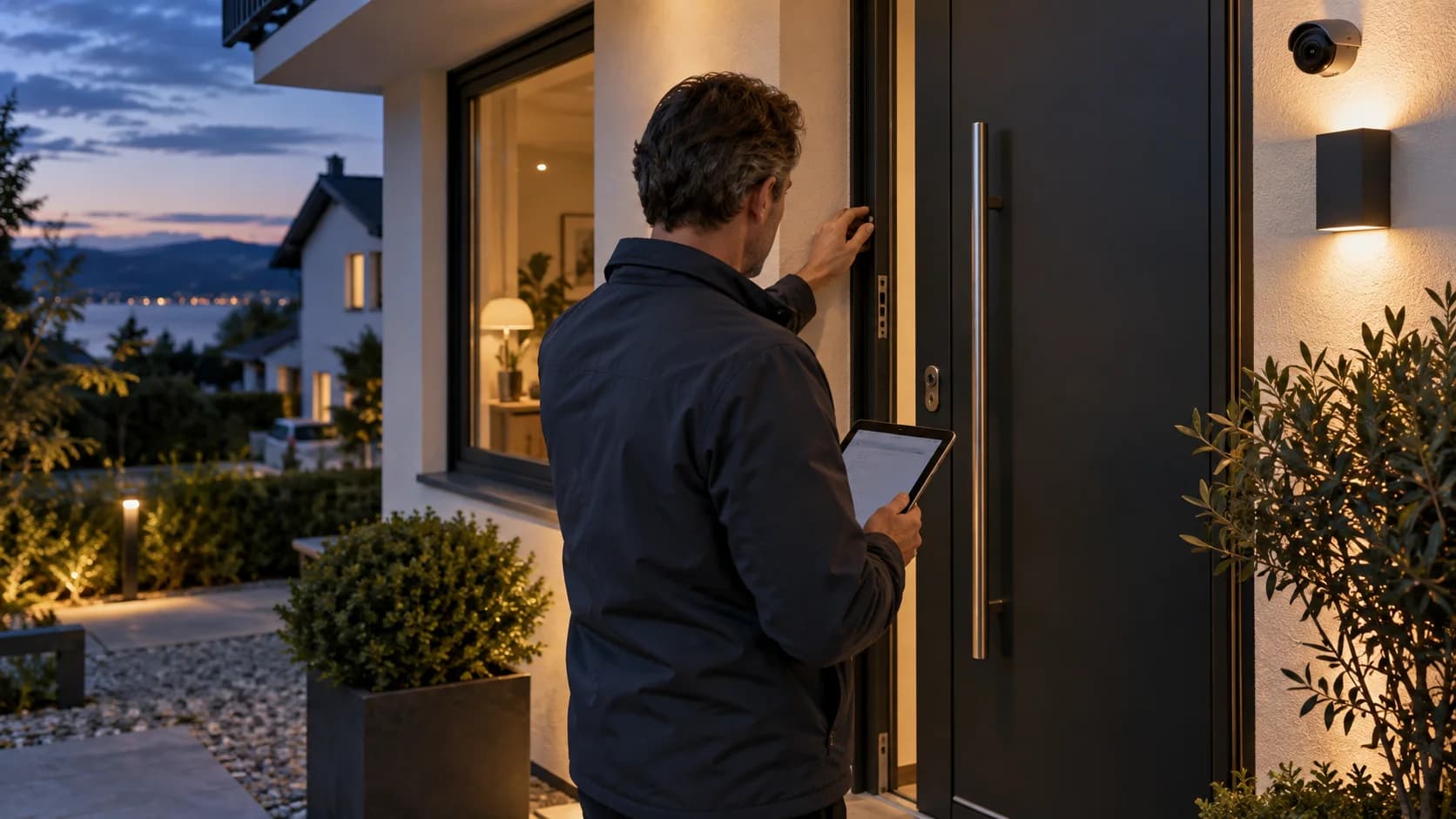
Evidence-based home security audit checklist: inspect, prioritize and verify
Audit doors, accessible windows, alarms, connected cameras and escape routes. Turn observations into a practical repair plan without mistaking a shopping list for a security assessment.
Security and resilience editorial team · Source-reviewed guidance based on public-agency publications; no professional certification, property inspection or laboratory testing is claimed.
Quick answer
Start with safe escape, then inspect every entrance and reachable window, check key control, test alarms, and review connected-device access. Record each weakness, its consequence, an owner and a verification step. Fix blocked exits and failed locks first. Add equipment only when it addresses a documented gap, and repeat the audit after repairs or household changes.
Key takeaways
- Inspect the complete entrance, including its frame, hinges and locking routine.
- Treat reachable upstairs windows as potential entry points too.
- Keep escape routes usable when security measures are engaged.
- Verify alerts and account permissions instead of relying on installation alone.
- Close each finding with evidence that the corrective action worked.
1. Build an audit record that leads to action
A useful home security audit records observable weaknesses and assigns a corrective action to each one. Start with a sketch of entrances, reachable windows and escape routes, then mark each check as passed, failed or unverified. Prioritize findings by their consequences and confirm repairs through a repeat inspection rather than a general feeling of safety.
Police guidance recommends checking doors and windows for weaknesses; USFA recommends mapping doors and windows for escape planning. Use the same sketch for both purposes. Include the garage connection, basement entrance, balcony door and any shared corridor. Inspect only areas you are authorized to access. In an apartment, record a defective communal entrance as an issue for the building manager rather than attempting to modify it yourself.
Our suggested worksheet has seven fields: location, observation, status, consequence, action, responsible person and closure evidence. Write concrete observations such as 'rear window does not latch' instead of 'window security poor'. An unverified setting deserves a follow-up task: 'camera access list not checked' is different from evidence that an unauthorized person has access.
Use three editorial priorities: immediate attention for an escape obstruction or an entrance that cannot secure; scheduled repair for damaged fittings or an unreliable alert; planned review for convenience improvements. These labels organize work and do not predict burglary probability. Do not add points across unrelated hazards: a functioning camera should never cancel out a failed door lock in your record.
Walk the property with another resident where possible. Ask each person to demonstrate the normal leaving-home routine and the way they would get out at night. Record disagreements as tasks to resolve. Keep the worksheet private because it describes weaknesses and household routines. A concise version for a landlord should contain the defect and requested repair, without unnecessary details about absences.
- • Create a numbered entry for every exterior door and reachable window.
- • Record what you observed and how you checked it.
- • Assign an owner and a target date to every failed or unverified item.
- • Keep photographs of defects and repairs in a private audit folder.
Sources for this section: Police Service of Northern Ireland: House Security, U.S. Fire Administration: Home Fire Escape Plans
2. Check doors, frames and control of keys
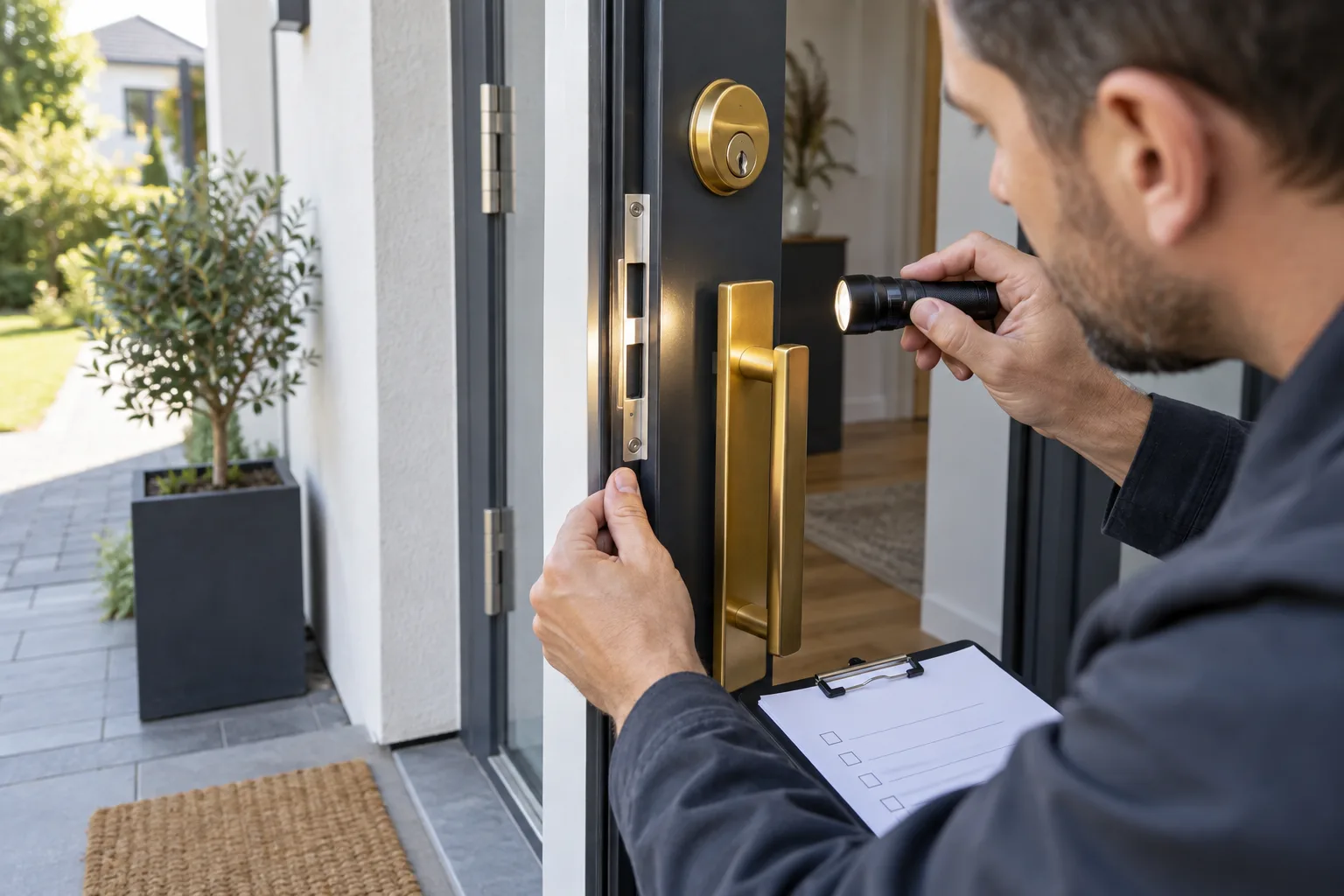
Check an entrance as a complete assembly: door, frame, hinges, lock and the way residents operate it. Confirm that the normal locking sequence actually secures the door. Review who holds keys and keep them away from openings. Refer damaged assemblies or uncertain lock compatibility to a qualified locksmith, while preserving safe escape.
Police.uk distinguishes closing a door from engaging its locks and describes the handle-lift and key-turn sequence used by some multipoint doors. Apply the instructions for your own mechanism rather than assuming every door works alike. During the audit, have one resident operate the lock and another check closure gently. Do not conduct forced-entry experiments or use tools to challenge the lock.
Give each entrance a separate record. Note visible frame damage, loose hardware, difficulty turning the key and whether the door aligns normally. Ask a locksmith to assess defects you cannot explain. Police.uk also discusses patio-door anti-lift protection and protruding cylinders; these are prompts for a professional compatibility check, not instructions to improvise modifications.
Create a private key register covering residents, relatives, former occupants and service access. If you cannot account for copies, discuss changing or rekeying the relevant lock. Store house and vehicle keys where they cannot be reached through a letterbox or an open window. Agree who is responsible for returning borrowed keys and how temporary access ends.
British standards mentioned in police guidance are jurisdiction-specific reference points. Ask the installer and insurer what evidence is appropriate for your property and location. For an apartment entrance, confirm fire-door requirements before changing hardware. Close the audit item only after normal locking and safe exit have both been demonstrated by the people who use the door.
- • Check the front, rear, balcony, basement and garage-to-house doors separately.
- • Verify the manufacturer's normal locking sequence.
- • Record damage or sticking without trying to force the mechanism.
- • Resolve missing keys and unexplained copies.
- • Confirm that residents can operate the exit with security engaged.
Sources for this section: Police.uk: Door and window lock advice, Police.uk: Door security, Police Service of Northern Ireland: House Security
3. Inspect reachable windows and verify detection
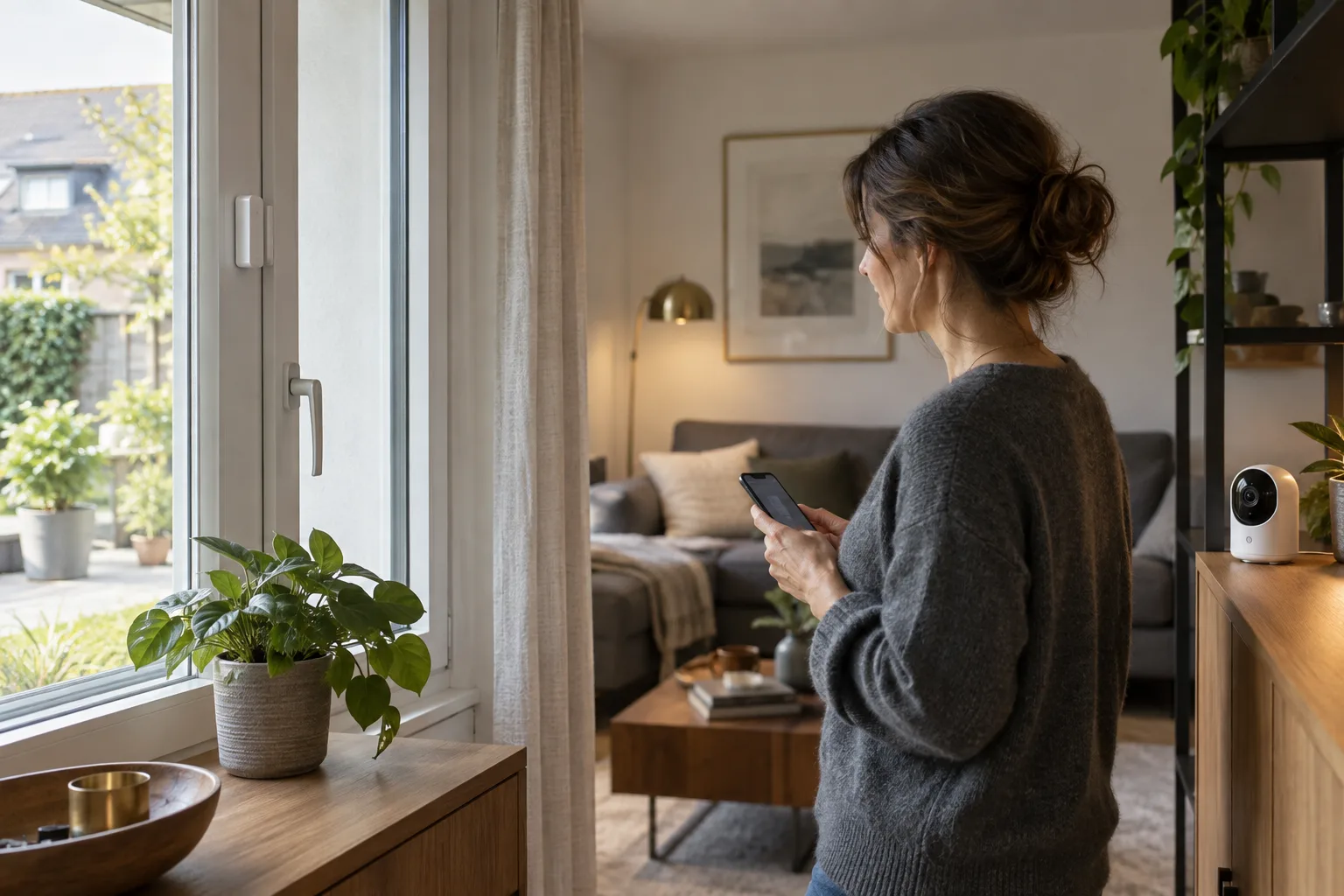
Assess windows by accessibility, not simply by floor number. Look for nearby objects that make a window reachable, confirm closure and locking, and record damaged fittings. If an alarm addresses a remaining detection gap, test its actual trigger and response. A sensor's presence does not establish that anyone will receive or act on an alert.
Police.uk asks residents to consider walls, bins and garden furniture that could provide access to windows. Inspect from safe ground and note what you can actually see. Include windows above a low roof or beside a balcony. Do not climb onto roofs or lean out to complete the checklist; mark inaccessible details as unverified and arrange an appropriate inspection.
Separate the physical defect from the detection question. A window that will not secure needs repair even if it has a sensor. Conversely, a sound window might still warrant an alert if the household has identified a practical monitoring need. Record why an additional device is being considered, which opening it would cover and who would respond.
For an existing alarm, follow its instructions and perform an authorized test. Record the trigger, the result, the receiving person and any delay you observed. If a service provider monitors the system, arrange testing through its process before activating it. Use manufacturer-approved methods; do not assume a local sounder, phone notification and monitored response are interchangeable.
The window-alarm-kit product reference is a category to compare when a detection gap remains. Its inclusion makes no claim about battery life, sound level, networking or compatibility. Before buying, request documentation for those properties and establish a maintenance routine. Recheck the underlying window repair and the chosen alert separately so that both findings have clear closure evidence.
- • List reachable windows, including those accessed from nearby structures.
- • Check each opening's closure and locking during normal use.
- • Move portable access aids where practical and authorized.
- • Test existing alerts using the documented procedure.
- • Name the person who will respond and define the next action.
| Finding | First action | Verification |
|---|---|---|
| Window will not secure | Arrange repair of the opening or hardware | Repeat normal closure and locking |
| Nearby bin provides access | Review its position | Inspect the revised arrangement from outside |
| Alarm response is unknown | Arrange an authorized test | Record the received alert and responsible person |
| Coverage gap remains | Compare suitable detection options | Test the chosen setup at the intended opening |
Sources for this section: Police.uk: Window security, Police Service of Northern Ireland: House Security
4. Audit camera access before expanding coverage
For connected cameras, review who can view recordings or change settings, then verify updates, account protection and available encryption. Limit coverage to a defined household purpose and document dependencies such as connectivity and storage. Select a camera only after confirming its security features in manufacturer documentation and testing the intended installation.
FTC guidance supports unique passwords, available two-factor authentication, software updates and secured home networking. Apply those checks to the camera account and the router. Review the current user list and remove access that no longer has a purpose. Record an unavailable feature as a limitation rather than assuming the app provides it.
Our camera worksheet asks for the exact model, installation position, account owner, support information, recording location and permissions. Add a practical acceptance test: with a consenting resident, check the view at the intended entrance in normal daytime and evening conditions, then locate and export a sample recording if that function is required.
Make the test match the decision. If you need to know whether a delivery arrived, inspect that scenario; if you need a record of an entrance event, check that it is captured and retrievable. Write down what the result cannot establish. A successful sample does not prove performance in every weather condition, lighting situation or connectivity failure.
The outdoor-security-camera reference is a relevant category, not an endorsement of a specific model. Compare documented access controls, update support and storage arrangements before considering visual specifications. Discuss the intended view with household members and minimize unnecessary recording. Police.uk explicitly reminds users to respect other people's privacy; obtain location-specific guidance when the planned view includes shared or public areas.
- • Inventory camera models and current authorized users.
- • Verify updates and available account protection.
- • Confirm documented encryption rather than relying on a security label.
- • Record the practical limitations of the installation.
- • Test the required recording and retrieval workflow.
Sources for this section: Federal Trade Commission: How To Secure Your Home Security Cameras, Police.uk: Door security
5. Preserve escape, rehearse response and close findings
A home security audit is incomplete until residents can leave safely and know what to do after an incident. Check escape routes with security measures engaged, maintain smoke alarms according to instructions, and rehearse the household plan. After suspected intrusion, prioritize personal safety, contact local police and avoid disturbing potential evidence.
USFA recommends smoke alarms in bedrooms, outside sleeping areas and on each level, with monthly testing and maintenance according to instructions. Its escape guidance calls for identifying two ways out of each room, keeping openings clear and choosing an outside meeting place. Treat these as U.S. reference guidance and check local requirements for your building.
Use a safe walkthrough to identify who needs help, which route each resident can use and whether locks or stored belongings obstruct it. Do not practice hazardous window exits. In an apartment building, obtain the building's fire instructions and identify the designated routes. Ask the relevant manager or fire-safety professional to resolve contradictions between security changes and the escape plan.
Write two short response cards: one for a fire alarm and one for suspected intrusion. The intrusion card should begin with getting to a safe place and contacting police; do not make entering the property or confronting someone part of the audit exercise. PSNI advises minimizing contact with objects after burglary to preserve forensic evidence. Use emergency contact information appropriate to your country.
Finish by reviewing every open item with its owner. Our suggested cadence is a brief monthly check of pending repairs and device maintenance, plus a fuller review after moving, changing occupants, losing keys or altering equipment. This is an editorial schedule, not a standard. A finding closes when the relevant check passes; an invoice or a delivered device alone is insufficient.
- • Check escape routes without creating a hazardous drill.
- • Record smoke-alarm test results and maintenance dates.
- • Assign assistance responsibilities and an outside meeting point.
- • Keep local emergency contacts accessible.
- • Reinspect repairs and record remaining limitations.
Sources for this section: U.S. Fire Administration: Smoke Alarms, U.S. Fire Administration: Home Fire Escape Plans, Police Service of Northern Ireland: House Security
FAQ
What should I fix before buying equipment?
Address an obstructed escape route or an entrance that cannot secure first. Then repair damaged fittings and verify existing alarms. Use equipment purchases to address specific findings that remain after those checks.
Can a tenant carry out this audit?
Yes. Record observations, perform normal operating checks and report defects. Agree structural or hardware changes with the landlord or manager, especially where a shared entrance or fire door is involved.
Does a camera replace a lock or alarm?
Give each measure a separate audit task. Check the entrance's physical security, the alert workflow and the recording workflow independently; a successful camera test does not close a failed lock finding.
Is this a certified security assessment?
No. It is a source-reviewed household checklist with an editorial prioritization method. It does not certify compliance, predict burglary probability or replace a professional inspection.
Methodology and sources
We searched for and fetched primary guidance from Police.uk, the Police Service of Northern Ireland, the U.S. Fire Administration and the U.S. Federal Trade Commission on 2026-10-04. The checklist combines their physical-security, fire-escape and camera-security guidance with an original editorial workflow for recording and prioritizing findings. It is not a validated risk score or an inspection certificate. British and American recommendations provide useful reference points but do not establish Polish legal requirements. Source publication dates are left null where a precise publication day was not established. Product references identify relevant categories only; we did not test products or verify individual capabilities.
- Police.uk: Door and window lock advice · accessed 2026-10-04
- Police.uk: Door security · accessed 2026-10-04
- Police.uk: Window security · accessed 2026-10-04
- Police Service of Northern Ireland: House Security · accessed 2026-10-04
- U.S. Fire Administration: Smoke Alarms · accessed 2026-10-04
- U.S. Fire Administration: Home Fire Escape Plans · accessed 2026-10-04
- Federal Trade Commission: How To Secure Your Home Security Cameras · accessed 2026-10-04